

Natalie Richy – Encaustic
Featured works
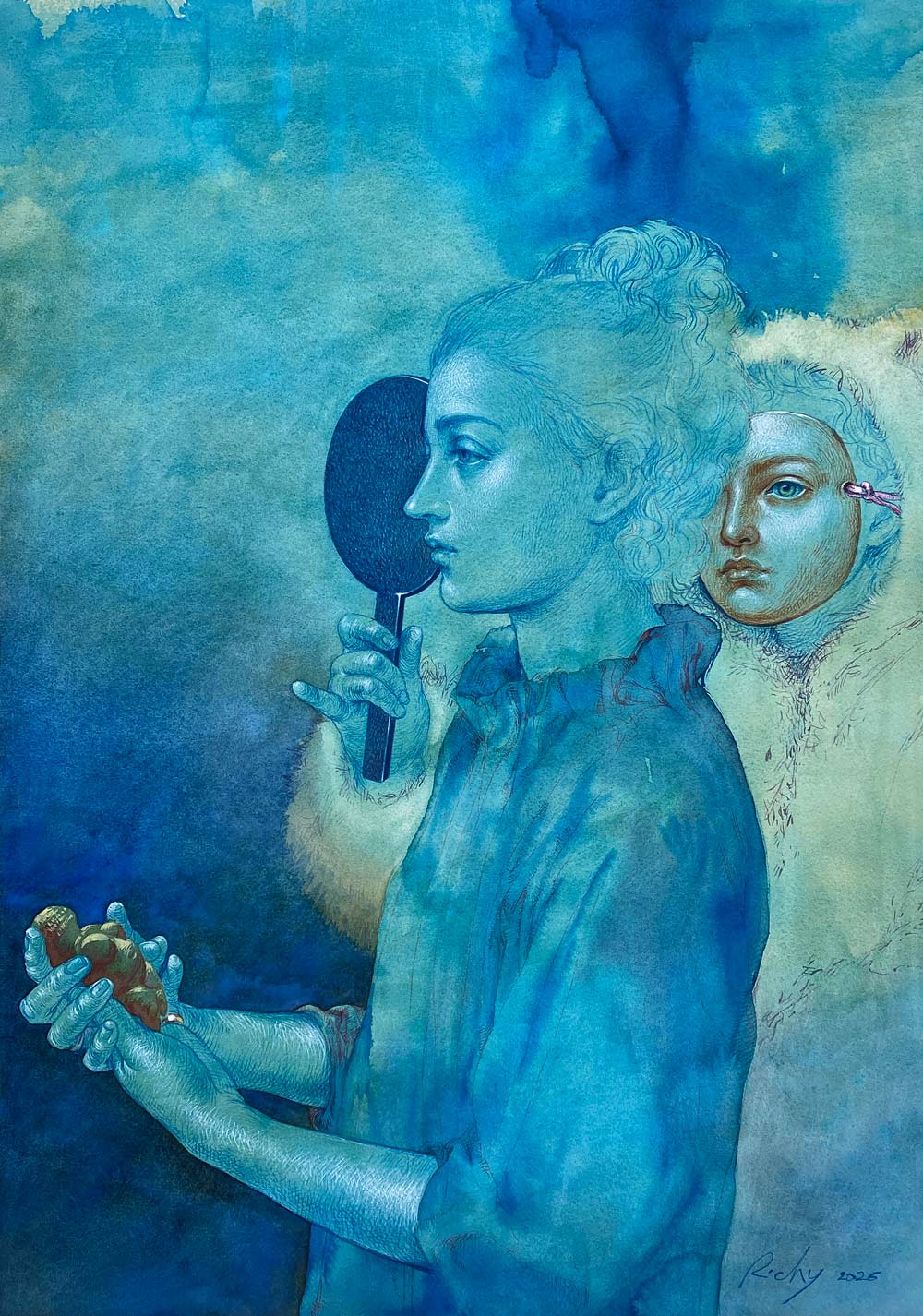
Self Portrait with a Mirror. Natalie Richy. 75 x 55 cm. Watercolor and Punic wax on paper. 2026
Natalie Richy: From Painting to Medal
Self-Portrait with a Mirror by Natalie Richy: Watercolor and Ancient Wax-Tempera Techniques
Natalie Richy's Self-Portrait with a Mirror combines the free-flowing washes of watercolor with a beeswax-based emulsion medium inspired by historical painting practices. This medium is associated with a traditional wax preparation known as Punic wax, a material described in ancient sources and explored in modern reconstructions of historical painting techniques.
Unlike ordinary beeswax, which is insoluble in water, an emulsified wax preparation can be mixed with water and used as a binder for colored pigments. In modern formulations, this is achieved by combining beeswax with an emulsifying agent, such as soap, or by using an alkaline solution to modify the wax and produce a water-mixable medium. The resulting paint can be applied cold with brushes, without the heating required for traditional hot encaustic painting.
Wax-based painting materials have a long history extending to the Greco-Roman world. Their possible use in ancient wall paintings, including those at Pompeii, and in the mummy portraits of Roman Egypt, commonly known as Fayum portraits, has been the subject of extensive technical and historical study. Although the precise composition of ancient wax-based paints and the extent of their use remain debated, modern reconstructions offer contemporary artists opportunities to explore materials and working methods associated with painting practices of nearly two millennia ago.
Beeswax-based paints can produce luminous, translucent, and richly colored surfaces, depending on their formulation and the pigments employed. Properly prepared wax emulsions also offer considerable versatility, allowing artists to combine wax-bound pigments with watercolor and other water-based painting media.
Because the paint is applied without heat, this technique is more accurately described as wax tempera or cold-wax tempera rather than traditional hot encaustic painting.
In Self-Portrait with a Mirror, Natalie explores the expressive possibilities of combining watercolor with a reconstructed historical wax medium. The fluid transparency of watercolor contrasts with the more controlled application and distinctive surface qualities of wax tempera. This combination allows her to create delicate hatching, subtle details, and freely flowing washes within the same composition.
Natalie continues to experiment with ancient and traditional painting materials in her contemporary figurative work. Her approach connects historical craftsmanship with modern artistic practice, giving her paintings a distinctive character shaped not only by their imagery and composition but also by her creative interpretation of historical materials and techniques.